





The Death of the Shopping Mall: WestShore Plaza Tells Us About Tampa's Future

For generations of Tampa residents, WestShore Plaza represented the future. When the mall opened in 1967, suburban America was booming. Families were moving away from traditional downtowns, automobiles were reshaping cities and enclosed shopping malls were becoming the new centers of American consumer life.

Nearly 60 years later, WestShore Plaza may once again offer a glimpse of the future. Only this time, the future involves tearing much of the old model down.
Third Lake Partners recently purchased the approximately 52-acre WestShore Plaza property for $135 million, advancing plans to transform the aging shopping center into a massive mixed-use development incorporating residences, retail, restaurants, offices, medical uses and recreational amenities.
The redevelopment represents much more than the decline of one Tampa mall. It reflects a fundamental change in how Americans live, work and shop.
The Mall Was Once Revolutionary
WestShore Plaza emerged during Tampa's postwar transformation.
As families moved into suburban communities, downtown shopping became increasingly inconvenient. Westshore offered abundant land, large parking lots and easy access to major roads.
The mall became one of the anchors around which the district grew.
Tampa International Airport was modernized nearby. Office towers followed. Hotels and restaurants appeared. Eventually, Raymond James Stadium arrived. Westshore became one of Florida's most important business districts. But the same forces that created the shopping mall eventually began working against it.
Consumers increasingly moved online. Department stores struggled. Retailers consolidated. Shopping became less about spending an afternoon wandering through an enclosed mall and more about convenience, dining and experiences.
WestShore Plaza's empty storefronts increasingly became evidence of an economic model reaching the end of its useful life. Yet the land beneath the mall became increasingly valuable.
Fifty-Two Acres in the Middle of Tampa
That is what makes WestShore Plaza particularly interesting.
The property isn't an abandoned shopping center on the outskirts of a declining city. It occupies approximately 52 acres in one of Tampa Bay's most important commercial districts, near Interstate 275, Tampa International Airport, International Plaza, Midtown Tampa and thousands of businesses.
Westshore is home to more than 6,500 businesses and is the region's largest employment center.
From a developer's perspective, using that much valuable urban land primarily for a low-rise shopping mall surrounded by enormous parking lots increasingly makes little economic sense.
The alternative is density.
Instead of having shoppers drive to the property for several hours and leave, developers can potentially create a neighborhood where thousands of people live and work.
Those residents then support restaurants, shops, entertainment and other businesses. The property becomes less of a shopping destination and more of a small city.
From Shopping Malls to Neighborhoods
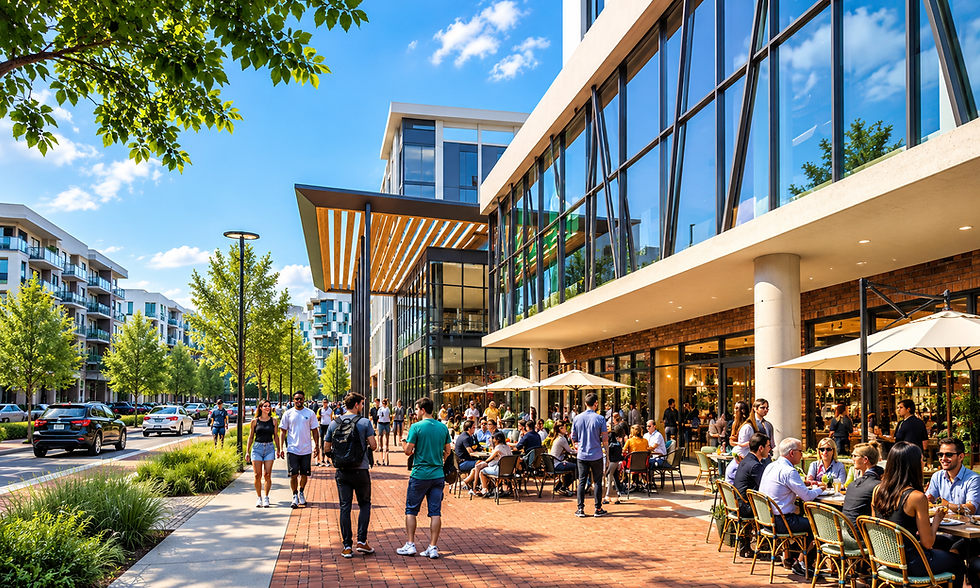
Tampa is already demonstrating that there is demand for this model. Midtown Tampa combines apartments, offices, restaurants, retail and a hotel within a pedestrian-oriented development. Its existing apartment building was recently reported at 98 percent leased, while its retail space was 95 percent leased.
The proposed WestShore Plaza redevelopment follows the same basic philosophy, only across a much larger piece of land. And just minutes away, another enormous mixed-use district is planned around the Tampa Bay Rays' new stadium at Hillsborough College.
The Rays' $2.36 billion ballpark was approved by Tampa and Hillsborough County in late August and is intended to become the centerpiece of a broader privately financed mixed-use development.
Taken together, these projects suggest Westshore is undergoing something much larger than redevelopment. The district itself is being redesigned. The challenge will be transportation.
Adding thousands of residents and visitors to an area already known for congestion will require better roads, pedestrian connections and transit. The reconstruction of the Interstate 275 interchange and proposed transportation improvements could therefore become as important to Westshore's future as the buildings themselves.
Still, the transformation of WestShore Plaza illustrates an important change taking place across Tampa.
The American shopping mall was built around the idea that people would drive somewhere to spend money.
The next generation of development is built around a different idea: Put people where they already live, work and spend money.
WestShore Plaza helped define Tampa's suburban expansion in the 20th century.
Its redevelopment may now help define Tampa's increasingly urban 21st century.


Comments